


What are the porosity - control requirements for ceramic saggers in porous ceramic production?
Jul 09, 2025
Leave a message
Hey there! As a ceramic sagger supplier, I've been getting a lot of questions lately about the porosity - control requirements for ceramic saggers in porous ceramic production. So, I thought I'd sit down and write this blog to share my knowledge and experiences on the topic.
First off, let's talk about what ceramic saggers are. Ceramic saggers are containers used in the firing process of ceramics. They protect the ceramic pieces from direct contact with the kiln atmosphere, prevent contamination, and help maintain the shape of the ceramics during firing. In porous ceramic production, the porosity of the sagger plays a crucial role.
The porosity of a ceramic sagger affects how well it can handle the gases and vapors that are released during the firing of porous ceramics. When porous ceramics are fired, they release various gases such as water vapor, carbon dioxide, and organic compounds. If the sagger has the wrong porosity, these gases can get trapped inside, leading to problems like cracking, warping, or uneven firing of the ceramic pieces.
One of the main porosity - control requirements is to ensure that the sagger has enough open pores to allow the gases to escape. The size and distribution of these pores are also important. For example, if the pores are too small, the gases may not be able to pass through easily. On the other hand, if the pores are too large, the sagger may not provide adequate protection to the ceramic pieces.
We need to control the porosity so that it matches the specific requirements of the porous ceramic being produced. Different types of porous ceramics have different gas - release characteristics during firing. For instance, some porous ceramics may release a large amount of water vapor in the early stages of firing, while others may release more carbon dioxide later on.
As a supplier, I often work closely with my customers to understand their needs. We test different sagger porosities for their specific porous ceramic production processes. By doing this, we can find the optimal porosity that allows for efficient gas escape without compromising the protection of the ceramic pieces.
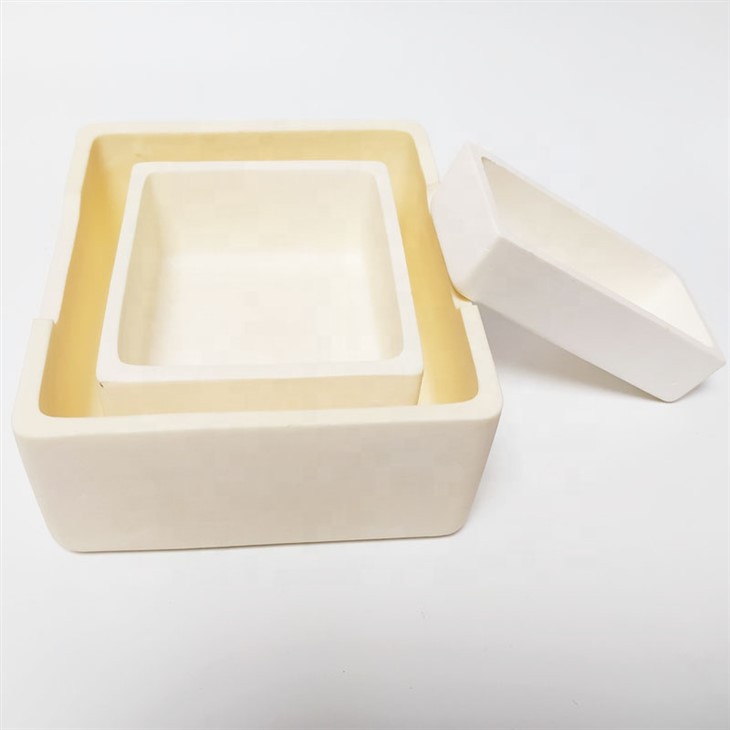

Let's take a look at some of the products we offer and how porosity control is important for them. We have the Fused Alumina Sagger. This type of sagger is known for its high - temperature resistance. In porous ceramic production, its porosity needs to be carefully controlled to ensure that it can withstand the high temperatures while still allowing the gases to escape.
Our Alumina Ceramic Box is another popular product. The porosity of this box affects its durability and its ability to protect the porous ceramics inside. If the porosity is not right, the box may crack or break during firing, which can damage the ceramic pieces.
The High - Performance Corundum Mullite Saggers For 5N Alumina & Indium Oxide Calcination are designed for specific high - end applications. For these saggers, porosity control is even more critical. The calcination process of 5N alumina and indium oxide requires precise gas management, and the right porosity ensures that the process goes smoothly.
There are several factors that can influence the porosity of ceramic saggers. The raw materials used are one of the main factors. Different clays, oxides, and additives can affect the pore formation during the manufacturing process. The firing temperature and time also play a role. Higher firing temperatures can sometimes reduce the porosity, while longer firing times may change the pore structure.
We use advanced manufacturing techniques to control the porosity of our saggers. For example, we can adjust the particle size of the raw materials. Smaller particles tend to create smaller pores, while larger particles can result in larger pores. We also use special additives that can help create a more uniform pore distribution.
Quality control is a big part of our work. We use various testing methods to measure the porosity of our saggers. One common method is the mercury intrusion porosimetry, which can accurately measure the pore size distribution. We also conduct visual inspections and firing tests to ensure that the saggers meet the required porosity standards.
In conclusion, porosity control for ceramic saggers in porous ceramic production is a complex but essential process. As a supplier, I'm committed to providing high - quality saggers with the right porosity for my customers' needs. If you're in the business of porous ceramic production and are looking for reliable ceramic saggers, I'd love to have a chat with you. Whether you're a small - scale producer or a large - scale manufacturer, we can work together to find the perfect sagger solution for your specific requirements. So, don't hesitate to reach out and start a conversation about your procurement needs.
References
- Smith, J. (2018). Porosity in Ceramic Materials. Journal of Ceramic Science, 25(3), 123 - 135.
- Brown, A. (2020). Firing Processes and Porosity Control in Ceramics. International Journal of Ceramic Technology, 30(2), 89 - 98.
- Green, C. (2021). Advanced Manufacturing of Ceramic Saggers. Ceramic Industry Review, 40(1), 45 - 52.
Send Inquiry