


What is the origin of the raw materials for Corundum Sagger?
Jan 14, 2026
Leave a message
As a supplier of Corundum Sagger, I've always been fascinated by the journey of its raw materials. Understanding the origin of these materials is crucial, not only for the quality of the final product but also for the overall efficiency and sustainability of the manufacturing process. In this blog, I'll take you through the sources and extraction processes of the key raw materials used in Corundum Sagger production.
The Primary Component: Corundum
Corundum is the cornerstone of Corundum Sagger. It is a crystalline form of aluminum oxide (Al₂O₃) and is known for its high hardness, excellent chemical stability, and remarkable thermal resistance. These properties make it an ideal material for saggers, which are used in high - temperature calcination processes.
Natural Corundum Deposits
Natural corundum can be found in various parts of the world. Some of the major deposits are located in Africa, particularly in countries like South Africa and Madagascar. In South Africa, the geological conditions have led to the formation of large - scale corundum deposits. The mining operations here involve both open - pit and underground mining methods. Open - pit mining is used when the corundum deposits are close to the surface. It allows for large - scale extraction, where heavy machinery is used to remove the overlying soil and rock layers to access the corundum ore.
Underground mining, on the other hand, is employed when the deposits are deeper. Miners dig shafts and tunnels to reach the ore bodies. This method is more complex and requires advanced safety measures. Once the ore is extracted, it undergoes a series of processing steps. First, it is crushed into smaller pieces to facilitate further separation. Then, techniques such as magnetic separation and flotation are used to purify the corundum from other minerals and impurities.
In Madagascar, the corundum deposits are often associated with gem - quality stones. The mining here is more artisanal in nature, with small - scale miners using basic tools to extract the ore. However, the quality of the corundum obtained can be quite high, and it is carefully sorted to separate the gem - grade and industrial - grade materials. Industrial - grade corundum from Madagascar is an important source for our Corundum Sagger production.
Synthetic Corundum Production
In addition to natural corundum, synthetic corundum also plays a significant role in the production of Corundum Sagger. Synthetic corundum is produced through a process called the Verneuil process or the Acheson process. The Verneuil process involves melting aluminum oxide powder in an oxy - hydrogen flame. The molten material is then allowed to solidify into a single - crystal or polycrystalline form. This process can produce high - purity corundum with consistent quality, which is essential for applications where precise performance is required.
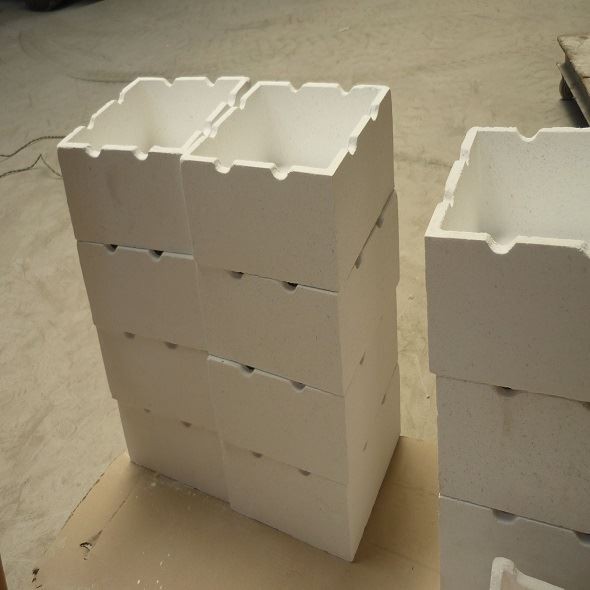

The Acheson process, on the other hand, is used to produce silicon carbide - bonded corundum. In this process, a mixture of aluminum oxide, silicon carbide, and other additives is heated in an electric furnace. The high - temperature reaction results in the formation of a corundum - based material with enhanced mechanical and thermal properties. As a supplier, we often use a combination of natural and synthetic corundum to achieve the desired balance between cost and performance in our Corundum Sagger products.
Other Supplementary Materials
Mullite
Mullite is another important material used in the production of Corundum Sagger, especially in the form of Corundum Mullite Sagger. Mullite is a mineral with the chemical formula 3Al₂O₃·2SiO₂. It has good thermal shock resistance and low thermal expansion, which helps to prevent the sagger from cracking during rapid heating and cooling cycles.
Mullite can be obtained from natural sources such as kaolin. Kaolin is a clay mineral that is rich in aluminum silicate. When kaolin is heated to high temperatures, it undergoes a series of chemical reactions and transforms into mullite. The kaolin deposits are widely distributed around the world, with major sources in the United States, the United Kingdom, and China.
In the United States, the kaolin mines in Georgia are well - known for their high - quality kaolin. The extraction process involves dredging the kaolin from open - pit mines. The raw kaolin is then processed to remove impurities and to adjust its particle size. After that, it is fired in a kiln to produce mullite. This mullite is then incorporated into our Corundum Mullite Sagger For Calcining Ternary Cathode Lithium Battery Powder to enhance its performance in the calcination of lithium battery powders.
Alumina
Alumina, or aluminum oxide, is also used as a supplementary material in some types of Corundum Sagger. High - purity alumina can be produced from bauxite, which is the most common ore of aluminum. Bauxite is mined in large quantities in countries like Australia, Guinea, and Brazil.
The Bayer process is the most widely used method for producing alumina from bauxite. In this process, bauxite is first crushed and then digested in a hot sodium hydroxide solution. The aluminum oxide in the bauxite reacts with the sodium hydroxide to form sodium aluminate. The impurities are then separated from the sodium aluminate solution, and the solution is seeded with alumina crystals to precipitate pure alumina. This high - purity alumina can be used to improve the chemical stability and mechanical strength of our Mullite Alumina Sagger For Calcining Metal Powder.
The Impact of Raw Material Origin on Product Quality
The origin of the raw materials has a significant impact on the quality of Corundum Sagger. For example, natural corundum from different regions may have different impurity levels and crystal structures. Corundum from South Africa may have a different trace element composition compared to that from Madagascar. These differences can affect the thermal conductivity, hardness, and chemical reactivity of the final sagger product.
Similarly, the quality of mullite and alumina depends on the quality of their respective raw materials. High - quality kaolin will produce mullite with better thermal shock resistance, while high - purity bauxite will result in alumina with superior chemical stability. As a supplier, we carefully select our raw material sources to ensure that we can produce Corundum Sagger with consistent and high - quality performance.
Sustainability Considerations
In recent years, sustainability has become an important factor in the sourcing of raw materials. We are committed to working with mining companies that follow sustainable mining practices. This includes minimizing the environmental impact of mining operations, such as reducing water pollution and land degradation.
We also encourage the use of recycled materials in our production process. For example, some of the waste corundum and mullite from previous production runs can be recycled and reused. This not only reduces the demand for new raw materials but also helps to lower the overall production cost.
Conclusion
The origin of the raw materials for Corundum Sagger is a complex and fascinating topic. From the natural corundum deposits in Africa to the synthetic production processes, each step in the sourcing and processing of these materials contributes to the quality and performance of our saggers. As a supplier, we are constantly exploring new sources of raw materials and improving our production processes to meet the evolving needs of our customers.
If you are interested in our High - Performance Corundum Mullite Saggers For 5N Alumina & Indium Oxide Calcination or other Corundum Sagger products, we welcome you to contact us for further discussion and procurement negotiation. We are dedicated to providing high - quality products and excellent services to our customers.
References
- "Mineral Deposits of the World" by John A. Wilson
- "Advanced Ceramics: Processing, Properties, and Applications" by David W. Richerson
- "Aluminum and Alumina Production Technology" by Peter Hayes
Send Inquiry